91³Ô¹ÏÍø

Watch CBS News

"Fireball meteor" lights up skies across Minnesota, Wisconsin

Some people were treated to an astral spectacle late Wednesday night, as a "fireball meteor" flashed across the night sky in parts of Minnesota and Wisconsin.

WCCO viewer Diane Lloyd captured footage of the meteor over Sartell, Minnesota, at about 10:15 p.m.

About 150 miles northeast of Sartell,  on Lake Superior also caught what may be the same meteor over the Aerial Lift Bridge.

The Neenah Fire Department in western Wisconsin also about the awe-inspiring sight.

"Last night at 10:13 p.m., as Officer Brent Wittman was leaving the ThedaCare Neenah Emergency Department, a meteor was seen lighting up the evening sky," police said.

According to the, there were nearly three dozen fireball reports in Minnesota on Wednesday between 10 p.m. and midnight, and more than 70 reports across Wisconsin.  

What is a "fireball meteor"?

as "a very bright meteor" that's "about the same magnitude of the planet Venus in the morning or evening sky. A bolide is a special type of fireball which explodes in a bright terminal flash at its end, often with visible fragmentation."
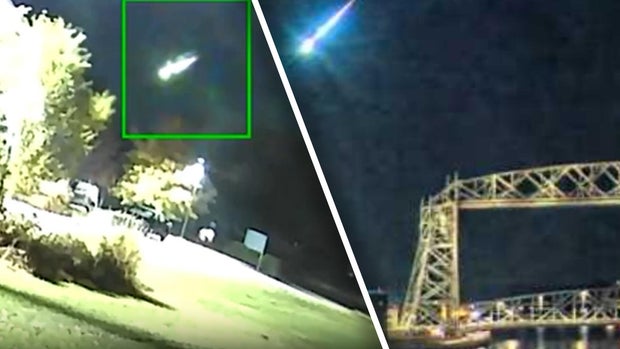
meteor.jpg
Diane Lloyd/Duluth Harbor Cam

NEXT Weather Meteorologist Adam Del Rosso said this isn't as uncommon as you'd think.

"Since most of the Earth is water, most never get observed. But with more cameras nowadays, we tend to catch them more," Del Rosso said. "They burn brighter since the rock/debris is a little larger than most meteors. Like other meteors, they usually burn up entirely in the atmosphere and don't leave any debris on the ground."

The society says there are several thousand fireball-magnitude meteors that reach Earth's atmosphere daily.

OK...but what's a meteor anyway?

Back in July, WCCO spoke with Thaddeus LaCoursiere of the Bell Museum, on the University of Minnesota's St. Paul campus. He said meteors come from comets, which consist of rock, dust and ice orbiting the sun. When comets get close to the sun, they heat up and form a fiery tail.

"The original starting point for these meteors that are coming from a meteor shower are generally from comets," LaCoursiere said. "That material in the comet's tail, it doesn't go back to [the comet]. It gets left behind."

LaCoursiere said when trying to watch a meteor shower, the first step is to look away from their point of origin.

"If I can find Capricorn in the sky, I face away from it because those meteors are going to come from behind my head, they're going to take a few seconds to enter the atmosphere, a few seconds to heat up, and so by the time we see them, we're looking opposite from where they came from," he said.

LaCoursiere also recommends getting away from light-polluted areas and finding the darkest sky possible for viewing. He also suggests letting your eyes adjust to darkness for 20 minutes before viewing, and warns that looking at your cellphone or another light source will then require another 20-minute adjustment period.
View CBS News In
CBS News App Open
Chrome Safari Continue
const link = doc.createElement('link'); link.rel = 'stylesheet'; link.href = '/fly/fly/bundles/cbsnewscontent/css/cmp-banner.min.css?v=fd53910ecf4604072044ab7c46d9b028'; doc.head.appendChild(link); doc.body.innerHTML = CONSENT_MESSAGE; } else { el.insertAdjacentHTML('afterend', CONSENT_MESSAGE); } }); } function hidePrivacyMessage() { // Remove from the main document document.querySelectorAll(`.${CONSENT_MESSAGE_CLASS}`).forEach(el => el.remove()); // Remove from inside any iframes document.querySelectorAll('iframe').forEach(iframe => { const doc = iframe.contentDocument || iframe.contentWindow.document; doc.querySelectorAll(`.${CONSENT_MESSAGE_CLASS}`).forEach(el => el.remove()); }); } function activateGatedScripts() { // Handle both new format (cmp-gated-script) and old OneTrust/Ketch format (optanon-category-4) const gatedScripts = Array.from(document.querySelectorAll('script.cmp-gated-script, script.optanon-category-4')); // Activate scripts sequentially with a small delay to avoid timing issues let delay = 0; gatedScripts.forEach(function(placeholder, index) { setTimeout(function() { // Skip if already processed if (placeholder.hasAttribute('data-cmp-processed')) { return; } placeholder.setAttribute('data-cmp-processed', 'true'); const newScript = document.createElement('script'); newScript.type = 'text/javascript'; // Try new format first (data-cmp-src), then fall back to old format (data-src) const src = placeholder.getAttribute('data-cmp-src') || placeholder.getAttribute('data-src'); if (src) { newScript.src = src; } else if (placeholder.textContent) { // Inline script - just copy the content newScript.textContent = placeholder.textContent; } // Handle new format attributes (data-cmp-attrs) - for both inline and external scripts const attrs = placeholder.getAttribute('data-cmp-attrs'); if (attrs) { const tempDiv = document.createElement('div'); tempDiv.innerHTML = '
<\/div>'; const tempAttrs = tempDiv.firstChild.attributes; for (let i = 0; i < tempAttrs.length; i++) { // For external scripts, allow defer/async. For inline scripts, skip them (not valid) if (src || (tempAttrs[i].name !== 'async' && tempAttrs[i].name !== 'defer')) { newScript.setAttribute(tempAttrs[i].name, tempAttrs[i].value); } } } // Copy other attributes from old OneTrust format for (let i = 0; i < placeholder.attributes.length; i++) { const attr = placeholder.attributes[i]; // Skip attributes we've already handled or don't want to copy if (!['class', 'data-src', 'data-type', 'data-cmp-src', 'data-cmp-attrs', 'data-cmp-processed', 'type', 'async', 'defer', 'src'].includes(attr.name)) { newScript.setAttribute(attr.name, attr.value); } } placeholder.parentNode.replaceChild(newScript, placeholder); // If external script, manually trigger window.onload handlers after it loads // This handles widgets that use window.onload for initialization if (src) { newScript.addEventListener('load', function() { // If page already loaded and script set a new onload handler, trigger it if (document.readyState === 'complete' && window.onload) { const originalOnload = window.onload; window.onload = null; // Clear temporarily to prevent loops originalOnload(); // Execute the handler } }); } }, delay); delay += 500; // 500ms delay between each script to allow full loading }); } cbsoptanon.onScriptsReady(function(cmp) { cmp.ot.targetingAllowed(function(allowed) { if (!allowed) { showPrivacyMessage(); } else { activateGatedScripts(); } }); cmp.ot.awaitInitialConsent(function(consent_model) { cmp.ot.addOnConsentChangedHandler(function() { cmp.ot.targetingAllowed(function(allowed) { if (allowed) { hidePrivacyMessage(); activateGatedScripts(); } else { showPrivacyMessage(); } }); }); }); });