Amazon says Prime scams are on the rise as the holidays near
Amazon.com is warning that scammers are just as eager as consumers to take advantage of holiday shopping deals, with bad actors trying to gain access to customers' Prime accounts through scam emails, calls and texts. The online retailer said it has seen a surge in criminal activity involving the ecommerce platform as shoppers use Amazon to make their holiday purchases.
Two types of scams are particularly on the rise, noted Amazon, whose annual pre-Black Friday promotion starts Nov. 17. Reports of so-called email attachment schemes have doubled in the second half of 2023, according to Amazon. These scams involve criminals posing as Amazon customer service representatives and sending shoppers attachments suggesting that their accounts will be suspended if they don't take action. The emails include a link asking for members' login credentials or payment information, which the scammers then steal.
"The bad thing isn't opening the attachment," Scott Knapp, Amazon's director of worldwide buyer risk prevention, told CBS MoneyWatch. "It's clicking on the link in the attachment, which goes straight to their website, where they start collecting all kinds of information."
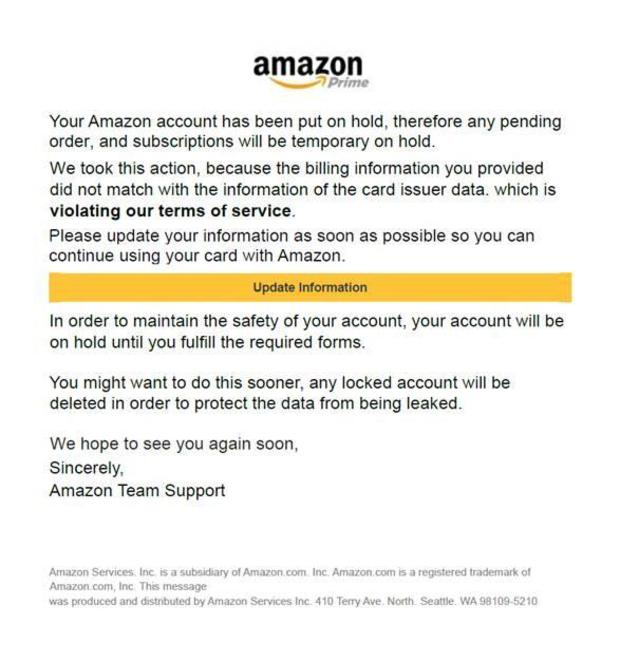
The second type of scam, which targets members of Amazon's Prime shopping club, has quadrupled over the same time period, according to the company. Scammers are also calling, texting and emailing Prime members about a bogus membership fee or account issue. They ask customers to confirm or cancel the charge by providing payment details, giving criminals the opportunity to steal sensitive information.
"Coming into the holiday with big deals, they send out notices that there's problem and say contact us to straighten things out. Give us your credit card information or bank account info to verify it," Knapp explained.
What Amazon will never ask for
Amazon said that this year it has shut down more than 45,000 phishing websites and over 15,000 phone numbers belonging to scammers.
Criminals can be surprisingly convincing in their efforts to pose as legitimate businesses. They are also known to send emails that look like order confirmations while claiming there's a problem with a customer's order. They then demand personal information in order to rectify the phony problem.
"A big red flag is when they start to ask for money or payment information over the phone or by email. That's something we would never do. We'd never ask for that," Knapp said.
How to spot a scam
Look out for these other tell-tale signs that an email or call that appears to be coming from Amazon or another legitimate business is the work of a scam artist trying to dupe you.
Asking for money. Scammers will sometimes insist that they be paid in order to resolve a customer account issue. Amazon said it would never ask that members pay them in this kind of scenario.
"That's something we would never do. We'd never ask for that," Knapp said.
Gift cards. Scammers often insist on being paid with gift cards because their details are easy to share, easy to redeem and hard to trace.
"People should be careful or wary when somebody is trying to make them pay for something only with a gift card. No legitimate transaction is going to require you to use gift cards. So be on the lookout for that," Knapp said.
Wait to respond. If you're on the receiving end of an unexpected communication from an alleged retailer, take a minute before responding.
"If it's something you didn't expect, pause before you start clicking on anything, texting someone back or calling them back. Verify it, go to the source, to our website or our app," Knapp advised..
Report fraud. Reporting fraud allows Amazon to investigate incidents and hold bad actors accountable, the company told CBS MoneyWatch. Additionally, anyone who believes they've been scammed can contact their bank or credit card issuer, which often are willing to reimburse customers while the firms investigate.
Knapp said customers are sometimes hesitant to report fraud because they're ashamed that they were taken advantage of. But he insists that fraud is "an equal opportunity industry, and people should not feel bad."
"Some of the smartest people in the world get taken by it — it doesn't matter if you're young or old," he added.