"Mammoth" carbon capture facility launches in Iceland, expanding one tool in the climate change arsenal
Hellisheidi, Iceland — With Mammoth's 72 industrial fans, Swiss start-up Climeworks intends to suck almost 40,000 tons of CO2 from the air annually to bury underground, vying to prove the technology has a place in the fight against global warming. Mammoth, the largest carbon dioxide capture and storage facility of its kind, launched operations this week situated on a dormant volcano in Iceland.
The facility adds significant capacity to Climework's first project, Orca, which also sucks the primary greenhouse gas that is fueling climate change out of the atmosphere.
How does Climeworks capture CO2?
Just 31 miles from an active volcano, the seemingly risky site was chosen for its proximity to the Hellisheidi geothermal energy plant necessary to power the facility's fans and heat chemical filters to extract CO2 with water vapor.
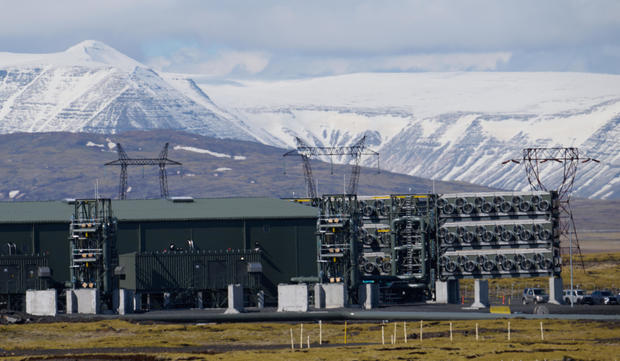
The CO2 is then separated from the steam and compressed in a hangar where huge pipes crisscross.
Finally, the gas is dissolved in water and pumped underground with a "sort of giant SodaStream," said Bergur Sigfusson, chief system development officer for Carbfix, which developed the process.
A well, drilled under a futuristic-looking dome, injects the water 2,300 feet down into the volcanic basalt that makes up 90% of Iceland's subsoil, where it reacts with the magnesium, calcium and iron in the rock to form crystals — solid reservoirs of CO2.
There are a number of other CO2 capture technologies being put to use around the world, including in the U.S., where the Biden administration has committed nearly $4 billion to jumpstart the industry.
The methods range from warehouses full of stacked limestone blocks that absorb CO2 like sponges to burying compressed industrial and agricultural waste to lock the gas away for centuries.
Lofty carbon capture ambitions
For the world to achieve "carbon neutrality" by 2050, "we should be removing something like six to 16 billion tonnes [17.6 U.S. tons] of CO2 per year from the air," said Jan Wurzbacher, co-founder and co-chief of Climeworks, at the inauguration of the first 12 container fans at Mammoth.
"I quite strongly believe that a large share of these... need to be covered by technical solutions," he said.
"Not we alone, not as a single company. Others should do that as well," he added, setting his start-up of 520 employees the goal of surpassing millions of tons by 2030 — and approaching a billion by 2050.
Speaking last year with CBS' 60 Minutes, Climeworks' chief technology officer Carolos Haertel said that technically the scaling up process can be done on a global scale — but he also said a single company can't do it, and he hinted that political will must also be behind the initiatives.
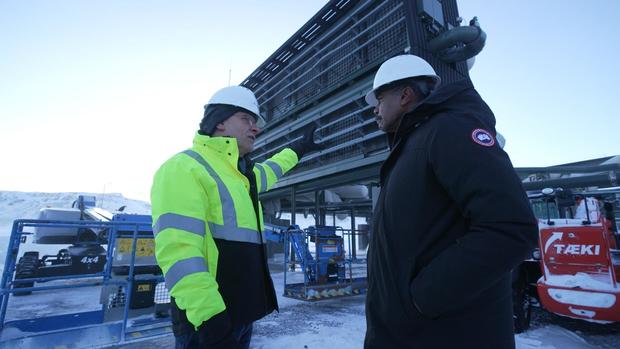
"Whether we are taking the right direction will depend as much on societal things than on technical matters," Haertel told 60 Minutes' Bill Whitaker at the Orca facility. "Am I optimistic as an engineer? I am, absolutely. Am I optimistic as a citizen? Maybe half-half. I haven't made my mind up yet."
Three years after opening Orca, Climeworks will increase its capacity from about 4,409 to 44,000 tons of CO2 captured annually once Mammoth is at full capacity — but that represents just seconds of the world's actual emissions.
One of the companies interviewed by CBS News in 2023 about its plans to ramp up carbon capture operations said it hopes to eventually be locking away 50,000 tons of CO2 per year.
Only part of the solution to address emissions
According to the Intergovernmental Panel on Climate Change (IPCC), the United Nations' climate expert body, carbon removal technologies will be necessary to meet the targets of the 2015 Paris Agreement, but major reductions of emissions are the priority.
The role of direct air capture with carbon storage (DACCS) remains minor in the various climate models due to its high price, and its deployment on a large scale depends on the availability of renewable energy to power it.
Climeworks is a pioneer, with the two first plants in the world to have surpassed the pilot stage at a cost of around $1,000 per ton captured. Wurzbacher expects that cost to decline to just $300 by 2030.
More than 20 new infrastructure projects, developed by various players and combining direct capture and storage, should be operational worldwide by 2030, with a combined capacity of around 11 million of tons.
"We need probably around $10 billion to proceed over the next decade to deploy our assets" in the United States, Canada, Norway, Oman and Kenya, said Christoph Gebald, Climeworks co-founder and co-chief. That's 10 times what the company has already raised.
"When I'm standing now at Orca I think: 'Oh this looks like a little bit like Lego bricks'. It's a tiny thing compared to Mammoth," Wurzbacher said.
Lego bought carbon credits generated by Climeworks for every ton of CO2 stored. The credits are a way of making the solution known to the general public, Gebald said, who has not ruled out selling credits to "big polluters" as well.
Critics of the technology point to the risk of giving them "license to pollute" or diverting billions of dollars that could be better invested in readily available technology such as renewable energy or electric vehicles.