DeepSeek AI raises national security concerns, U.S. officials say

As Chinese AI application DeepSeek attracts hordes of American users, Trump administration officials, lawmakers and cybersecurity experts are expressing concern that the technology could pose a threat to U.S. national security.
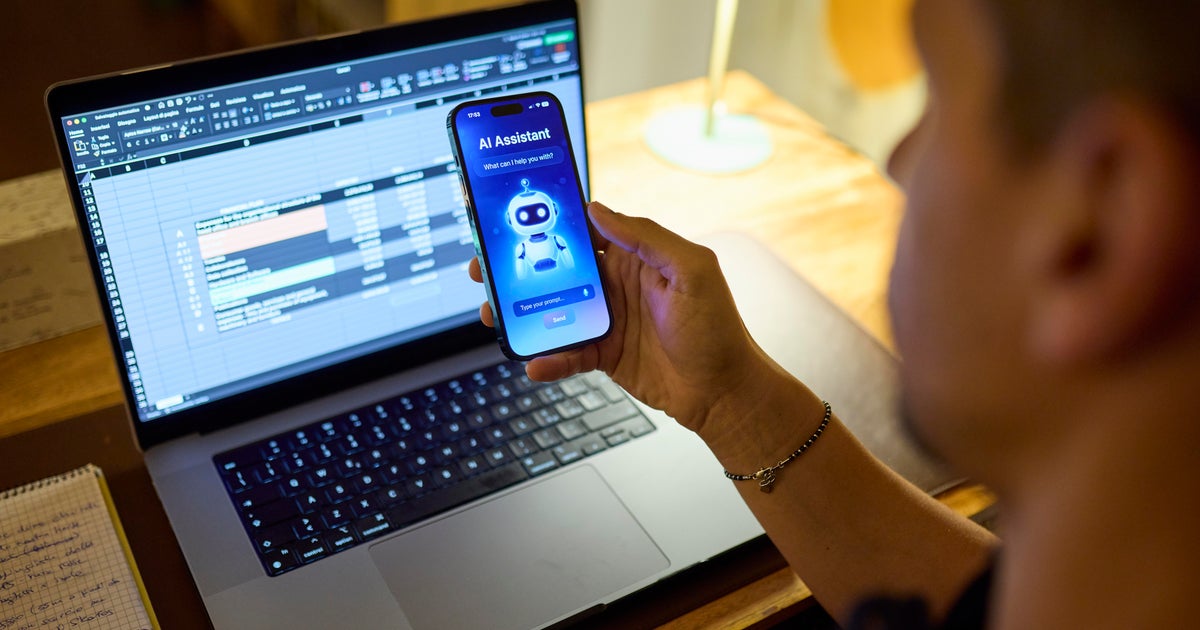
DeepSeek's introduction in the U.S. on Monday saw it quickly become the most downloaded free application in the country on Apple's app store. The rollout also rocked Wall Street as investors struggled to compute the sudden appearance of a low-cost, open-source generative AI tool able to compete with leading artificial intelligence apps such as OpenAI's ChatGPT.
Shares of Nvidia, the U.S. manufacturer of advanced chips engineered for AI development, plummeted 17%, chopping roughly $600 billion off its market value — a record single-day drop for a U.S. stock.
That explosive debut was branded a "wake-up call" by President Trump on Monday. Addressing reporters on Tuesday, White House Press Secretary Karoline Leavitt said the National Security Council (NSC) would examine the potential national security implications around DeepSeek's launch, noting that the administration would seek to "ensure American AI dominance."
Some lawmakers also weighed in with concerns about the application's access to U.S. users.
"The U.S. cannot allow Chinese Communist Party models such as DeepSeek to risk our national security and leverage our technology to advance their AI ambitions," Rep. John Moolenaar, a Michigan Republican who chairs the bipartisan House Select Committee on the Chinese Communist Party, said Tuesday in a shared on social media. "We must work to swiftly place stronger export controls on technologies critical to DeepSeek's AI infrastructure."
The spotlight on DeepSeek comes amid rising tensions over trade, technology and other issues between the two superpowers. The U.S. has already imposed significant export controls on China in an effort to rein in Beijing's production of semiconductors used in developing advanced AI, with the most recent curbs coming in .
"At the President's direction, the NSC and others in the U.S. government work in many ways to address concerns involving AI, China and data security," agency spokesperson Brian Hughes told CBS News in an email. "As the President has underscored, U.S. policy is to ensure that the United States leads the world in AI."
Security threat for users
While the calls from Moolenaar could be the first inkling of a possible congressional crackdown, Ross Burley — a co-founder of the nonprofit Centre for Information Resilience — warned that DeepSeek's emergence in the U.S. raises data security and privacy issues for users. Chinese law grants Beijing broad authority to access data from companies based in China.
"More and more people will use it, and that will open the door to more and more personal data just being given away to the [Chinese Communist Party] and being sent basically to mainland China to be able to inform them of their activities," Burley told CBS News.
"What they'll use it for is behavior change campaigns, disinformation campaigns, for really targeted messaging as to what Western audiences like, what they do," he added.
DeepSeek, which is based in the Chinese city of Hangzhou, notes in its privacy policy that the personal information it collects from users is held "on secure servers located in the People's Republic of China."
Under that , the company says it collects information including users' "device model, operating system, keystroke patterns or rhythms, IP address, and system language." DeepSeek also collects "service-related, diagnostic, and performance information, including crash reports and performance logs," according to the company.
A key difference from TikTok
The fact that DeepSeek's servers are based in mainland China differentiates it from TikTok, the Chinese-owned social media platform that Congress had sought to ban on national security grounds before President Trump signed an executive order last week directing the Justice Department to not enforce the law for a period of 75 days.
In an effort to mitigate U.S. regulatory concerns, TikTok's parent company, ByteDance, in 2022 all of its U.S. data to infrastructure owned by American software maker Oracle.
The legislation banning TikTok — the "Protecting Americans from Foreign Adversary Controlled Applications Act," which President Biden signed into law last April — grants the federal government broad scope to crack down on tech platforms owned by countries regarded as U.S. adversaries.
Under that law, Congress can compel a platform to divest its U.S. operations from foreign ownership, and it can be shut down if it qualifies as a threat. The law can apply to any platform that allows users to share content; has more than 1 million monthly active users; is owned by a company located in a foreign adversary-controlled country; and has been determined by the president to present a significant national security threat.
But DeepSeek may be seen as less of a threat given that, unlike TikTok, it is an open-source large language model, according to Matt Sheehan, a China fellow at the Carnegie Endowment for International Peace.
"[A] lot of these open-source apps, open-source models, you can actually sort of use them directly on other platforms. Perplexity is a major U.S. AI company, and they're currently using a version of DeepSeek that you can use that doesn't have the data privacy or security threats," he told CBS News.
Advancing censorship?
One issue that DeepSeek users face outside of China: censorship. For example, a CBS News analysis of the application found that DeepSeek did not return any results for a prompt seeking information bout the 1989 Tiananmen Square protests and subsequent massacre in Beijing.
Burley of the Centre for Information Resilience thinks such suppression of information on an app being downloaded by millions of users will pressure policymakers to act.
"I think it's incumbent on Western governments — the U.K., Canada, the U.S. — to look and see if it is wise for the Apple store and the Android store to host this large language model when it is so clearly being curated to push Chinese narratives and censorship," he said.