How much will an electric vehicle really cost you? Here's what to know.
With electric vehicle prices tumbling in recent months, consumers are facing new considerations about whether EVs could provide overall savings when compared with gas-powered cars. The answer, experts say, may not always be clear cut.
"What I like to say is that comparing gas to EV is like comparing oranges to 20 different breeds of apples," said Keith Barry, a writer for Consumer Reports who focuses on the car industry.
There are several factors to consider when it comes to cost, including the price tag of new and used EVs, electricity costs in your state and how and where you plan to charge your car. Even though EV prices are coming down, they still remain higher on average than gas-powered vehicles, which can be an immediate turnoff for some buyers.
At the same time, EVs can deliver lower maintenance and fuel costs, putting more money back into owners' pockets, according to a released Wednesday by nonprofit Coltura.
"Comparing a gas sedan to an EV, the differential we found is always positive, as in an EV is always cheaper," said Ron Barzilay, a data and policy associate at Coltura.
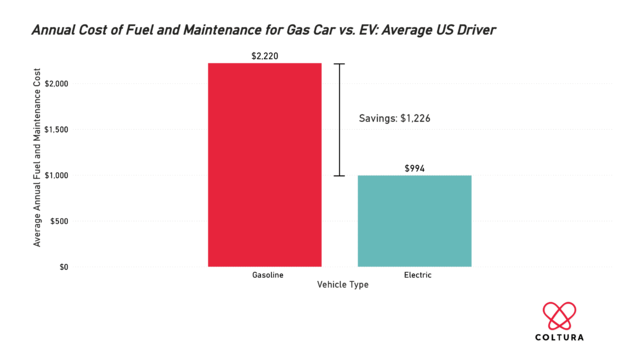
Coltura's findings show that the average EV driver saves $100 a month in fuel and maintenance costs, and that "superusers," or drivers who guzzle up to more than 100 gallons of gas a month, would save an average of $400 a month by switching to an EV.
Here are some of the cost tradeoffs between EVs and gas vehicles, according to the data and industry experts.
What is the price of a new EV?
The price tag on new electric vehicles is still higher than gas-powered vehicles. Kelley Blue Book that prices on new EVs dropped from $65,000 in May 2022 to $56,648 in May 2024, a 15% decline. But the average transaction price for gas-powered cars in July was still cheaper at $48,401, to Kelley Blue Book.
That's partially because most automakers haven't fully ventured outside of the luxury market yet. "That's where the highest margins are," said Barry.
As the technology to build them gets cheaper, automakers will start to shift to more affordable models, and in turn prices will drop.
What about used EVs?
The real place for finding a deal on an EV is in the used market. According to a report from , used EVs under $30,000 now make up 60% of the inventory. As of May 2024, the average price for a used EV was $28,767, per an .
"When the price starts to fall on new products, used ones drop even further," said Barry.
What are the fuel and maintenance savings with an EV?
A new analysis from Coltura found that the average American driver – who drives about 11,000 miles a year – saves 8.1 cents per mile on fuel by driving an EV. That, plus, amounts to over $1,200 a year in savings.
That's partly because electricity prices are cheaper and more predictable than the more volatile gas market, said Matthew Metz, founder and co-executive director of Coltura. Coltura plans to update the index quarterly.
A found that electric vehicles have 80% more problems and are less reliable than their gas-powered equivalents. As the new kids on the block, they are still working out certain technology kinks, experts say.
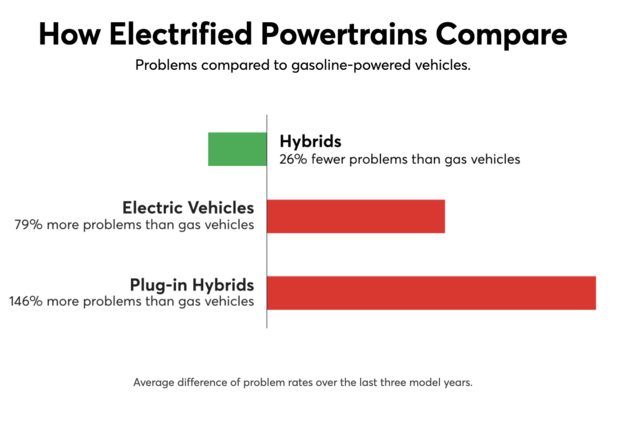
"It doesn't really so much relate to them being electric vehicles," said Metz "It's just having this sort of new generation of electronics."
But while the reliability rating of EVs may be lower than gas-powered cars due to unexpected problems that can arise, everyday wear and tear costs tend to be lower. For instance, there's no need for oil changes or tune ups, and EVs have a more streamlined system under the hood.
"You don't have all of the parts that are in a gas-powered car that can go wrong," said Barry. "So when an EV works as it's supposed to, it's going to be cheaper in terms of maintenance."
The one nuisance for owners might just be tires, Barry said. EVs, with their heavier build, tend to wear down rubber quicker.
Does my location impact charging costs?
Chances are if you're in New England, you won't be paying what your friend out on the West Coast is paying. That's because electricity costs and energy costs vary widely based on region.
"It's really hard to generalize what's going to cost less," Barry said.
Electricity is generally cheaper than gas, but there are outlier cases where you might be better off driving a hybrid, said Barry.
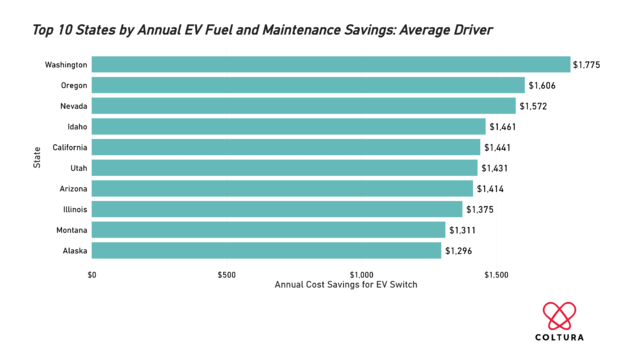
Coltura broke down the top 10 states with the highest savings. The west coast came out on top with Washington and Oregon in the top two slots.
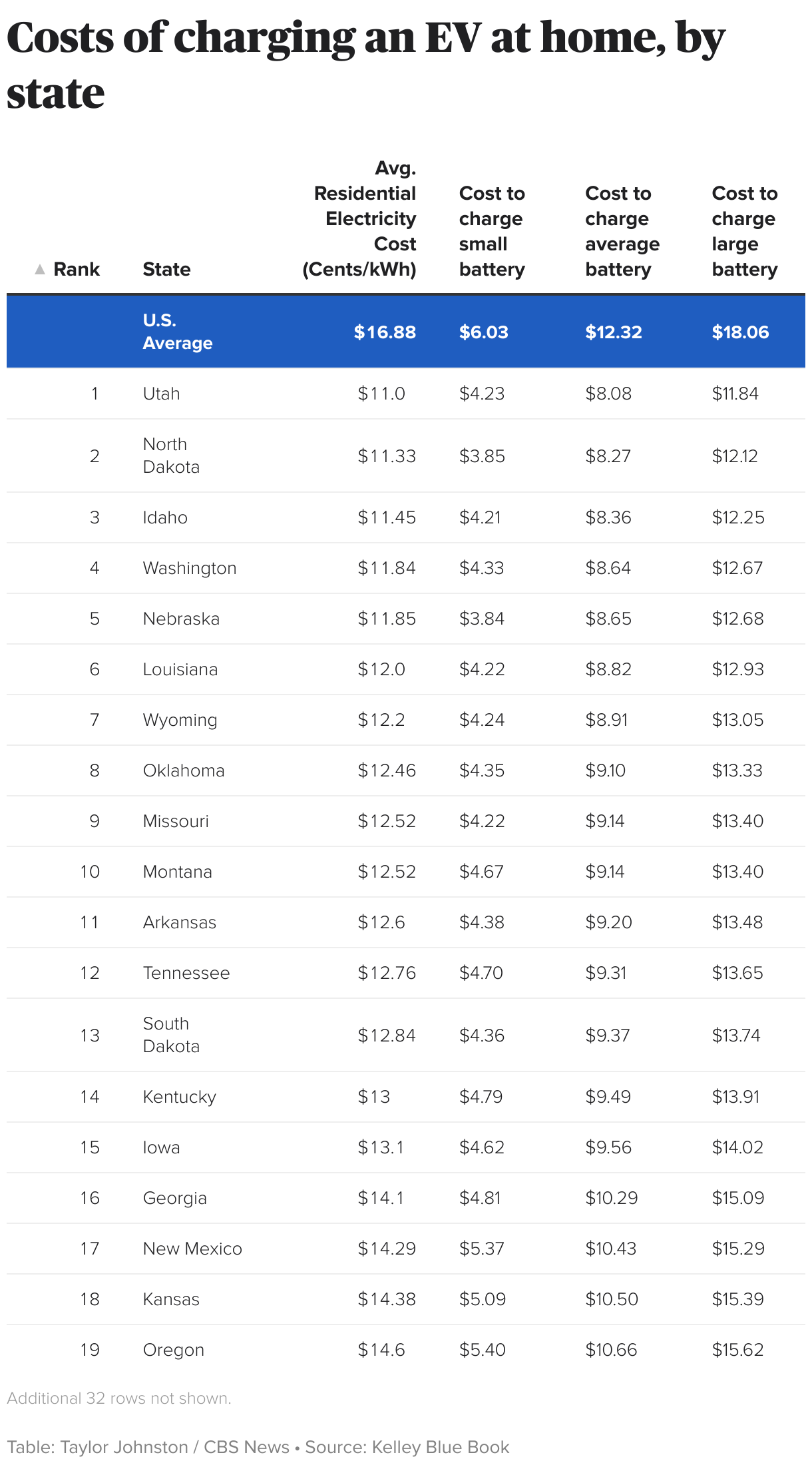
Kelley Blue Book also has a (see below) that tabulates at-home charging costs by state using data from the U.S. Energy Information Administration.
Are EV discounts available?
The government is offering consumers a federal tax credit of up to $7,500 for new EVs and up to $4,000 for used EVs. There are some strings attached, though, such as meeting .
Over 150,000 people have taken advantage of the discount so far this year, to the Department of Treasury, which .
Local, state, and utility incentives are also available for those looking to subsidize their car cost, Barry said. You can search deals in your state on the Department of Energy's Alternative Fuels Data Center .
How much does it cost to install an at-home charging station?
to HomeAdvisor, the cost can range anywhere from $550 and $1,385. Level 1 chargers are on the cheaper end, with average prices between $300-$600, while Level 2 chargers, which charge EVs faster, can cost between $700-$2,000, including labor costs.
But it's not a fixed scale. How much you spend may hinge on other factors, like the electrical infrastructure in your home. The cost could creep into the thousands, Barry said, if you have to do more heavy lifting, like digging trenches to lay down wires.
"If you live in a new construction home, or if you have a recently upgraded electrical panel it's very inexpensive," said Barry. "[But] you might have a 200-year-old house where you have to get the whole electrical system upgraded."
While the upfront cost may scare some off, Metz said at home chargers should be looked at as a "long-term asset" for homeowners. "The value will pass over," he said.