More Americans are having to choose between food and energy bills
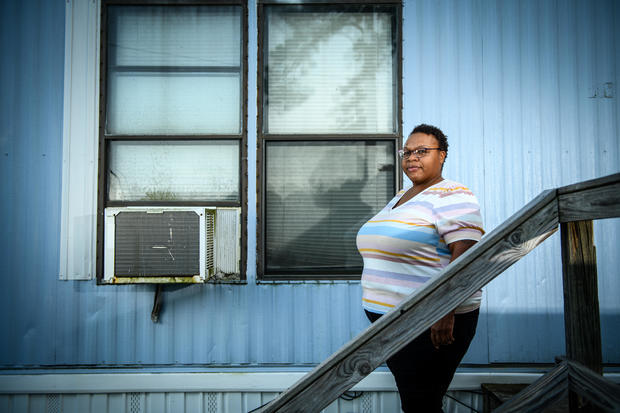
Charlotte, N.C. — During the heat dome that blanketed much of the Southeast in June, Stacey Freeman used window units to cool her poorly insulated mobile home in Fayetteville, North Carolina. Over the winter, the 44-year-old mom relied on space heaters.
In both instances, her energy bills reached hundreds of dollars a month.
"Sometimes I have to choose whether I'm going to pay the light bill," Freeman said, "or do I pay all the rent or buy food or not let my son do a sport?"
As a regional field organizer for PowerUp NC, Freeman's job is to help people properly weatherize their homes, particularly in the Sandhills region, where she lives and works and where poverty and rising temperatures make residents vulnerable to the health impacts of climate change.
But Freeman's income is too high to benefit from the very services she helps others attain from that grassroots sustainability, clean energy, and environmental justice initiative.
Like a growing number of Americans, Freeman struggles with what is known as , including the inability to afford utilities to heat or cool a home. Households that of their income on energy bills are energy-poor, some researchers suggest.
Energy poverty can increase one's exposure to extreme heat or cold, which raises the risk of developing respiratory issues, heart problems, allergies, kidney disorders, and other health conditions. And the burden falls disproportionately on households in communities of color, which experience it at a rate 60% greater than those in white communities.
Public health and environmental experts say that as climate change continues to create extreme weather conditions, more policy efforts are needed to help vulnerable communities, especially during heat waves.
"Energy poverty is just one example of how climate change can exacerbate existing inequities in our communities," said Summer Tonizzo, a spokesperson for the North Carolina Department of Health and Human Services.
Extreme heat is the No. 1 cause of weather-related deaths in the U.S., a risk that grows as temperatures rise. Last year, 2,302 people in the U.S. , a 44% increase from 2021. In one week in early July this year, extreme heat killed at least 28 people, , based on reports from state officials, medical examiners, and local news reports.
Yet, 1 in 7 households spend about 14% of their income on energy, according to RMI, an energy and sustainability think tank. Nationally, are in energy poverty, concluded an analysis co-authored by Noah Kittner, an assistant professor of public health at the University of North Carolina-Chapel Hill.
"Old, inefficient buildings and heating systems are prompting people to supplement their energy needs in ways that increase the costs," Kittner said.
Pregnant women, people with heart or lung conditions, young children, older adults, and people working or exercising outdoors are most at risk for heat-related health concerns. High temperatures are also correlated with mental health issues such as suicide and severe depression.
Location is another risk factor. For example, in a historically Black community in Raleigh, known as Method, temperatures can be 10 to 20 degrees hotter than nearby areas with more vegetation and less development, said La'Meshia Whittington, an environmental justice and clean energy advocate. Interstate 440 runs through Method, and the city stores shuttle buses there, often with engines running.
"That creates a lot of pollution that heats up the neighborhood," Whittington said. "There's no land to soak up the heat. Instead, it bounces off shingles, roofs, pavement and creates a stove."
Method residents frequently complain of chronic headaches and respiratory problems, she said.
While rural areas tend to have lower temperatures than nearby urban areas because they have less asphalt and more trees, they often lack resources, such as health care facilities and cooling centers. Substandard housing and higher rates of poverty contribute to high rates of heat-related illness.
Energy poverty "is the layering of burdens without a means, at the individual level, to combat those burdens," said Ashley Ward, director of the Heat Policy Innovation Hub at Duke University.
In many parts of the country, extreme heat is a relatively new concern. Policymakers have historically focused on threats from colder temperatures.
The federal government's Low Income Home Energy Assistance Program, established more than four decades ago, has a funding formula that over those that experience extreme heat, according to research from Georgetown University. Florida, Georgia, Arizona, Texas, and Nevada have the lowest proportional allocations of federal funding, while North Dakota, South Dakota, and Nebraska have the highest.
North Carolina has largely relied on private donors and local nonprofits, such as PowerUp, to distribute fans and air conditioning units in the summer, but the state doesn't contribute to the costs of energy bills.
On extremely hot days, Freeman and her PowerUp NC colleagues work with state health officials to direct vulnerable people to cooling centers.
On a personal level, staying cool this summer meant sending her son to a free, open recreational center, rather than paying for him to join a sports league.
"We're doing stuff that doesn't cost," she said. "Just trying to keep up with the electric bill."
is a national newsroom that produces in-depth journalism about health issues and is one of the core operating programs at — the independent source for health policy research, polling, and journalism.