How Israel's Iron Dome intercepts rockets
Hamas and other Palestinian militant groups fired more than 4,500 rockets toward Israel in the first three days after Hamas' deadly Oct. 7, 2023, terrorist attack, according to Israel Defense Forces. Most of those rockets have been intercepted by Israel's Iron Dome missile defense system.
The barrages of rockets set off air raid sirens in Jerusalem and Tel Aviv. They've also sparked concerns about flight safety at Ben Gurion International Airport.
The Iron Dome technology, declared operational in 2011, has a success rate of around 90-97%, the IDF has said in recent years. Israeli officials have not specified how successful it has been since Hamas launched its deadly incursion from Gaza over the weekend. Hundreds of people have been killed since the surprise assault.
How the Iron Dome works
Iron Dome, developed by Israel's Rafael Advanced Defense Systems, uses radar, advanced tracking technology and anti-missile batteries to follow the trajectory of incoming rockets and mortars. According to an , the technology determines if rockets are headed toward a populated area and, if they are, Iron Dome fires Tamir interceptors at the incoming projectiles. Rockets that don't pose a threat are allowed to fall into empty areas.
Iron Dome has an interception range of 2.5 to 43 miles. The interceptors cost as much as $100,000 apiece. Some cost estimates are lower, with the Institute for National Security Studies reporting in 2021 that an interceptor missile is about $40,000 - $50,000.
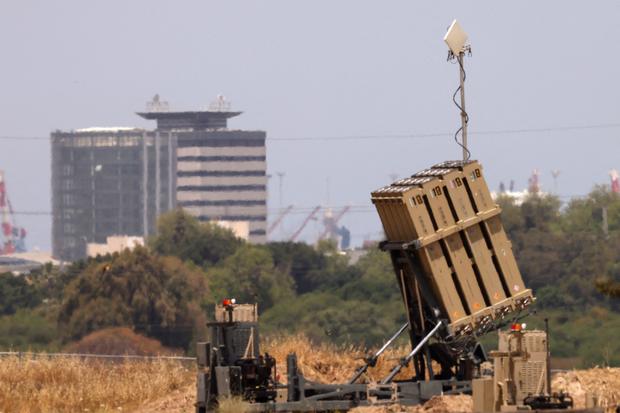
Israel has at least 10 Iron Dome batteries throughout the country. Each one is designed to defend a 60-square-mile populated area. The batteries can be moved as threats change.
According to Raytheon, a U.S. defense contractor that produces some of the components of the Iron Dome's interceptors, each battery has three launchers loaded with up to 20 Tamir interceptor missiles each.
The Israeli Air Force said the system destroyed 85 percent of the rockets headed toward Israeli towns and cities during the serious conflict between Israel and Hamas in 2012. That success rate has gone up — Israel's Defense Ministry said that Iron Dome successfully intercepted 97% of all targets it engaged during a summer 2022 confrontation in which Palestinian Islamic Jihad fired rockets into Israel.
Why was Iron Dome created
Israel's Brig. Gen. Daniel Gold first had the idea for Iron Dome in 2004, according to Israel Defense Forces. Israel's military started development on Iron Dome in response to rocket attacks launched by Hezbollah during the 2006 war in Lebanon. It cost $210 million to develop.
Didi Ya'ari, then CEO of Rafael, the lead Israeli manufacturer of the system, told "60 Minutes" in 2013 that Iron Dome was a game changer because it allowed the Israeli economy to continue to function in times of conflict.
"People go to work. Harbors are working. Cars are moving, trains are moving. Nothing stops. And still you have circumstances [that] in the past, you would consider as full war," Ya'ari said at the time.
America's role in Iron Dome
While the system was developed in Israel, it was financed in part by hundreds of millions of dollars from the United States. The U.S. became interested in becoming a partner in production and, in 2014, Congress called for Iron Dome technology sharing and co-production with the U.S.
The U.S. and Israeli governments signed a co-production agreement in March of 2014, enabling the manufacture of Iron Dome components in the United States, while also providing the U.S. with full access to what had been proprietary Iron Dome technology, according to a March report from Congressional Research Service.
Military contractor Raytheon is Rafael's U.S. partner in the co-production of Iron Dome. Interceptor parts are manufactured at Raytheon's missiles and defense facility in Tucson, Arizona and elsewhere and then assembled in Israel.
To date, the U.S. has provided for Iron Dome batteries, interceptors, co-production costs and general maintenance, according to a March report from Congressional Research Service. In 2021, the House approved a bill providing $1 billion for the defense system.
A senior U.S. Defense official addressed the Iron Dome system during a Oct. 9: "Let me just say at this point, for every request that our Israeli counterparts have made of us, we are able to meet those requests," the official said. "And one of those areas, of course, is ongoing discussion about the air defense needs they have."