Sarah McBride on her run to become first trans member of the House
It is a typical election year scene: A Congressional candidate working the crowd at a college football game. But Sarah McBride's simple act of shaking hands at Delaware State University could lead to a turning point in American history. If elected, she would become the first trans member of the U.S. House of Representatives.
Asked what that means to her, McBride replied, "It is a testament to Delawarians that the candidacy of someone like me is even possible."
When "Sunday Morning" first met McBride during the pandemic, she was already making history as the first trans person ever elected to a state senate seat, becoming America's highest-ranking transgender elected official. Now, at age 34, with almost two terms under her belt, she is running for higher office, but says it is not about her identity as a trans woman:

"I think that folks know that I am personally invested in equality as an LGBTQ person," she said. "But my priorities are going to be affordable child care, paid family and medical leave, housing, health care, reproductive freedom."
Her Republican opponent in the Congressional race is a former Delaware State Police officer, John Whalen III. His top priorities are stopping illegal immigration and reducing the federal debt. He did not want to do an interview for this story, but during a brief phone conversation, when asked if McBride's being a trans woman would be a factor in the race, he said, "There's more important things than that."
Professor Danna Young, director of the Center for Political Communication at the University of Delaware, agrees. "I think voters really do want to hear about other issues," she said.
In 2018, Young co-authored a study on attitudes toward transgender candidates. "We asked people if they would be willing to support a transgender candidate if that candidate were from their own party," Young said. "And the results showed that there really was not a lot of support for a transgender candidate."
But now, she questions whether that study would hold up today, especially because it wasn't tied to a specific transgender candidate like Sarah McBride. "People know her now, especially in a state that's small," Young said.
By now, Delaware voters are familiar with McBride's story, including how she met her future husband, a trans man named Andrew Cray, at an Obama-era White House reception. "Andy was the kindest, funniest, smartest person that I ever met," said McBride.
Cray would die from cancer just four days after their wedding.
Professor Young says all that has strengthened Sarah McBride: "She's tough. I do not worry about her ability to take whatever attacks are likely to come her way at the national level," Young said.
But on the national level, the Republican candidate for president is putting transgender issues front-and-center, for example, falsely charging that schoolchildren are undergoing surgical procedures: "The transgender thing is incredible … Your kid goes to school, and comes home a few days later with an operation," Donald Trump recently told the conservative group Moms for Liberty.
McBride said, "I wouldn't be the first person in Congress to be part of a community that Donald Trump has said outrageous things about."
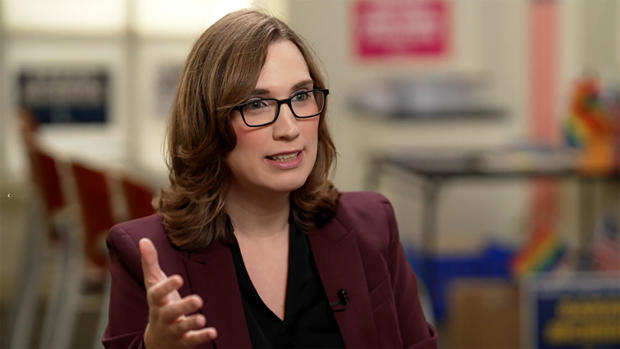
Asked how she could make peace with other members of Congress who have railed against trans people, McBride said, "I think the ones who are really caught up on this, the folks who are those professional provocateurs? They're not gonna work with any Democrat. They can barely work with their own Republican colleagues."
had McBride leading in this heavily Democratic state by more than 20 points. And if she is elected, McBride believes that she will not be the last trans member of Congress:
"We know throughout history that the power of proximity has opened even the most closed of hearts and minds," she said. "And I still believe that the power of proximity taps what I believe to be the most fundamental human emotion, which is empathy."
For more info:
- Photos courtesy of
Story produced by Robert Marston. Editor: George Pozderec.