91³Ô¹ÏÍø

Watch CBS News

Underwater voyage finds sea creatures thriving in the deepest parts of the ocean

An underwater voyage has revealed a network of creatures thriving at the bottom of deep-sea ocean trenches, researchers said in .

The deep-sea trenches, also called Hadal trenches, are "some of the Earth's least explored and understood environments," the researchers wrote. In these extreme environments, the crushing pressure, scant food and lack of sunlight can make it hard to survive. Scientists know that tiny microbes prosper there, but less is known about evidence of larger marine life.

Researchers traveling along the Kuril–Kamchatka and Aleutian trenches in the northwest Pacific Ocean used a manned submersible to find tubeworms and mollusks flourishing at over 31,000 feet deep. The deepest part of the ocean goes down to about 36,000 feet.

Scientists had surveyed this area before and had hints that larger creatures might live at such depths. The new discovery confirms those suspicions and shows just how extensive the communities are, said Julie Huber, a deep sea microbiologist with Woods Hole Oceanographic Institution.

"Look how many there are, look how deep they are," said Huber, who was not involved with the research. "They don't all look the same and they're in a place that we haven't had good access to before."
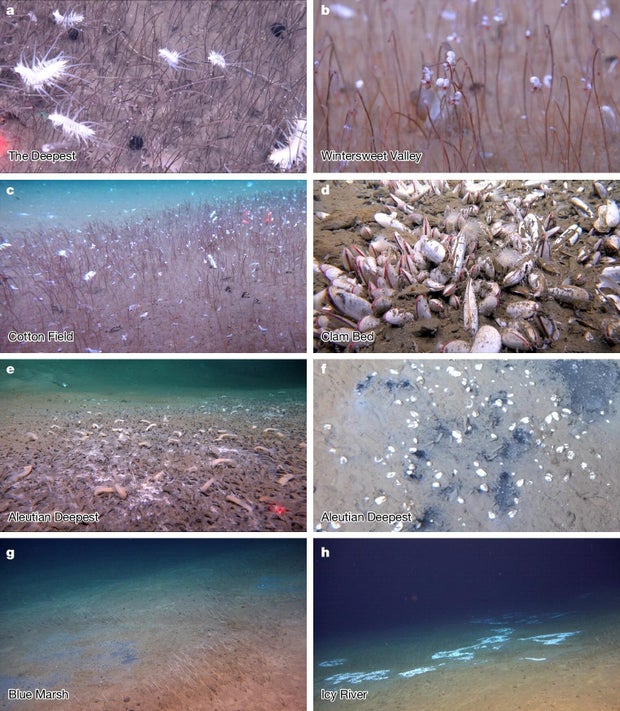
41586-2025-9317-fig2-html.jpg
A number of life forms found by researchers in the trench, including a clam bed and tube-dwelling polychaetes.  Nature

In the absence of light to make their own food, many trench-dwellers big and small survive on key elements like carbon that trickle down from higher in the ocean.

Scientists think microbes in this new network may instead be capitalizing on carbon that's accumulated in the trench over time, processing it to create chemicals that seep through cracks in the ocean floor. The tubeworms and mollusks may survive by eating those tiny creatures or living with them and snacking on the products of their labor, scientists said. 

"These findings challenge current models of life at extreme limits and carbon cycling in the deep ocean," the study's authors wrote. The researchers said that trench-dwelling life forms "may be more widespread than previously anticipated." 

With this discovery, future studies will focus on how these deep-sea creatures adapted to survive in such extreme conditions and how exactly they harness chemical reactions for food, study authors Mengran Du with the Chinese Academy of Sciences and Vladimir Mordukhovich with the Russian Academy of Sciences said in a statement.

Their existence challenges "long-standing assumptions about life's potential at extreme depths," the authors said.
View CBS News In
CBS News App Open
Chrome Safari Continue
const link = doc.createElement('link'); link.rel = 'stylesheet'; link.href = '/fly/fly/bundles/cbsnewscontent/css/cmp-banner.min.css?v=fd53910ecf4604072044ab7c46d9b028'; doc.head.appendChild(link); doc.body.innerHTML = CONSENT_MESSAGE; } else { el.insertAdjacentHTML('afterend', CONSENT_MESSAGE); } }); } function hidePrivacyMessage() { // Remove from the main document document.querySelectorAll(`.${CONSENT_MESSAGE_CLASS}`).forEach(el => el.remove()); // Remove from inside any iframes document.querySelectorAll('iframe').forEach(iframe => { const doc = iframe.contentDocument || iframe.contentWindow.document; doc.querySelectorAll(`.${CONSENT_MESSAGE_CLASS}`).forEach(el => el.remove()); }); } function activateGatedScripts() { // Handle both new format (cmp-gated-script) and old OneTrust/Ketch format (optanon-category-4) const gatedScripts = Array.from(document.querySelectorAll('script.cmp-gated-script, script.optanon-category-4')); // Activate scripts sequentially with a small delay to avoid timing issues let delay = 0; gatedScripts.forEach(function(placeholder, index) { setTimeout(function() { // Skip if already processed if (placeholder.hasAttribute('data-cmp-processed')) { return; } placeholder.setAttribute('data-cmp-processed', 'true'); const newScript = document.createElement('script'); newScript.type = 'text/javascript'; // Try new format first (data-cmp-src), then fall back to old format (data-src) const src = placeholder.getAttribute('data-cmp-src') || placeholder.getAttribute('data-src'); if (src) { newScript.src = src; } else if (placeholder.textContent) { // Inline script - just copy the content newScript.textContent = placeholder.textContent; } // Handle new format attributes (data-cmp-attrs) - for both inline and external scripts const attrs = placeholder.getAttribute('data-cmp-attrs'); if (attrs) { const tempDiv = document.createElement('div'); tempDiv.innerHTML = '
<\/div>'; const tempAttrs = tempDiv.firstChild.attributes; for (let i = 0; i < tempAttrs.length; i++) { // For external scripts, allow defer/async. For inline scripts, skip them (not valid) if (src || (tempAttrs[i].name !== 'async' && tempAttrs[i].name !== 'defer')) { newScript.setAttribute(tempAttrs[i].name, tempAttrs[i].value); } } } // Copy other attributes from old OneTrust format for (let i = 0; i < placeholder.attributes.length; i++) { const attr = placeholder.attributes[i]; // Skip attributes we've already handled or don't want to copy if (!['class', 'data-src', 'data-type', 'data-cmp-src', 'data-cmp-attrs', 'data-cmp-processed', 'type', 'async', 'defer', 'src'].includes(attr.name)) { newScript.setAttribute(attr.name, attr.value); } } placeholder.parentNode.replaceChild(newScript, placeholder); // If external script, manually trigger window.onload handlers after it loads // This handles widgets that use window.onload for initialization if (src) { newScript.addEventListener('load', function() { // If page already loaded and script set a new onload handler, trigger it if (document.readyState === 'complete' && window.onload) { const originalOnload = window.onload; window.onload = null; // Clear temporarily to prevent loops originalOnload(); // Execute the handler } }); } }, delay); delay += 500; // 500ms delay between each script to allow full loading }); } cbsoptanon.onScriptsReady(function(cmp) { cmp.ot.targetingAllowed(function(allowed) { if (!allowed) { showPrivacyMessage(); } else { activateGatedScripts(); } }); cmp.ot.awaitInitialConsent(function(consent_model) { cmp.ot.addOnConsentChangedHandler(function() { cmp.ot.targetingAllowed(function(allowed) { if (allowed) { hidePrivacyMessage(); activateGatedScripts(); } else { showPrivacyMessage(); } }); }); }); });