U.S. soldier's newlywed wife released after being detained by immigration agents on base in Louisiana
The wife of a U.S. Army staff sergeant has been released from immigration detention as removal proceedings move forward after she was detained just days after their wedding while on a Louisiana military base, where the couple was planning to live together.
Annie Ramos, a 22-year-old college student, was released Tuesday, according to the Department of Homeland Security and TheDream.US, a nonprofit that provides scholarships to undocumented immigrants.
"I am deeply grateful to my husband, Matthew, who never stopped fighting for me, and to our families and community who surrounded us with love, prayers, and support. Because of them, I am home," Ramos said in a released by the nonprofit. "All I have ever wanted is to live with dignity in the country I have called home since I was a baby. I want to finish my degree, continue my education, and serve my community — just as my husband serves our country with honor."
In a statement to CBS News on Tuesday, DHS said Ramos was released on order of supervision with a GPS monitor while she undergoes further removal proceedings.
The effort to remove Ramos, who was born in Honduras, has drawn backlash from military family advocates, who called the detention demoralizing in a time of war and warned that deporting spouses could undermine recruitment.
Staff Sgt. Matthew Blank said he brought his wife to his base in Fort Polk, Louisiana, last Thursday so that she could begin the process to receive military benefits and take steps toward a green card. The couple married in March.
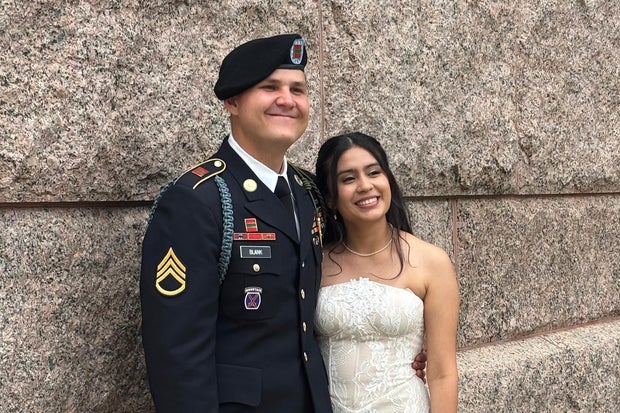
Federal immigration agents detained Ramos as part of the Trump administration's mass deportation agenda, which legal experts say has dispensed with DHS's practice of leniency toward families of military members.
"I never imagined that trying to do the right thing would lead to her being taken away from me," Blank, 23, said in a statement to The Associated Press. "What was supposed to be the happiest week of our lives has turned into one of the hardest."
"Our plan was to drive over, bring her to the office to get her military ID and activate her military spouse benefits," Blank told The Times. "She was going to move in after the Easter weekend. Instead, she got ripped away from me."
Ramos entered the U.S. in 2005, when she was younger than 2 years old. That same year, her family failed to appear for an immigration hearing, leading a judge to issue a final order of removal, according to DHS.
"She has no legal status to be in this country," DHS said in an emailed statement. "This administration is not going to ignore the rule of law."
Ramos' detention and release were first .
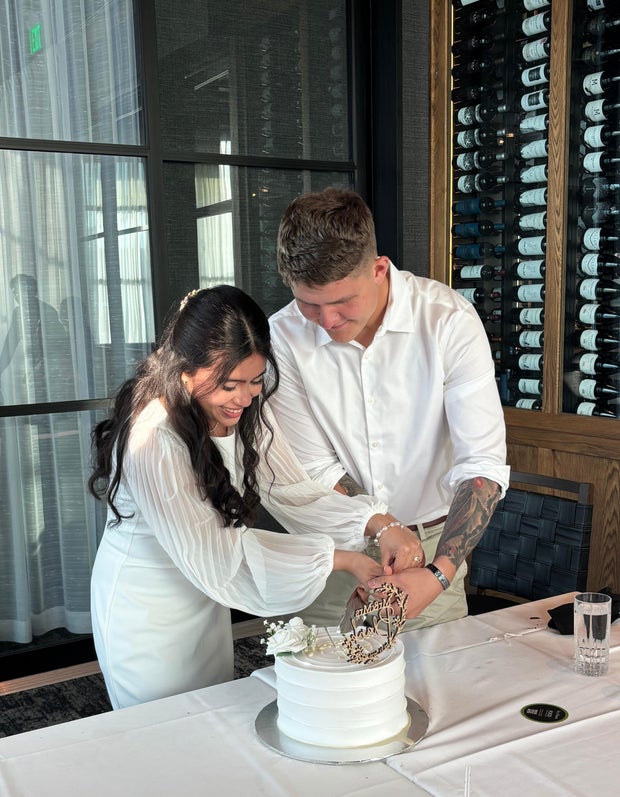
In 2020, Ramos applied to receive Deferred Action for Childhood Arrivals, also known as DACA, but her husband says her application has remained "in limbo" amid legal fights to end the Obama-era program.
Last April, DHS eliminated a 2022 policy that considered military service of an immediate family member to be a "significant mitigating factor" in deciding whether or not to pursue immigration enforcement. The administration's new policy states that "military service alone does not exempt aliens from the consequences of violating U.S. immigration laws."
Prior to the Trump administration's mass deportation push, DHS generally allowed the spouses of active-duty military members to gain legal status through policies like parole in place and deferred action that military recruiters promote, according to Margaret Stock, a military immigration law expert.
Ramos' case would have been easy to resolve in the past, Stock said, but instead DHS now appears to be focusing on detaining members of military families whenever the opportunity arises — including when, like Ramos, they are attempting to apply for legal status.
"It doesn't make any sense — they're going to get arrested for following the law? That's stupid," Stock said. "It's bad for morale, it disrupts the soldiers' readiness."
In September, more than and the Department of Defense warning that arrests of military personnel and veterans' family members were "betraying its promises to service members who play a key role in protecting U.S. national security."
"To make matters worse, the Trump administration may be targeting military families using information they voluntarily provided to the federal government in connection with their service," the lawmakers said in the letter.
The Pentagon declined to comment.
Lydiah Owiti-Otienoh, who runs an advocacy group called the Foreign-Born Military Spouse Network, said she's anecdotally seen an increase in cases where the lives of military families have been upended by tightening immigration restrictions. She believes the federal government is undermining its own interests by attempting to deport military spouses.
"It just sends a really bad message — we don't care about you, about your spouses, anything you are doing," Owiti-Otienoh said. "If military families are not stable, national security is not stable."
Blank's mother, Jen Rickling, told The AP in a statement that her daughter-in-law, a Sunday school teacher and biochemistry major, had been everything she hoped for — someone who "loves my son with her whole heart."
"We absolutely adore her," Rickling said. "I believe in this country. And I believe we can do better than this — for Annie, for other military families, and for the values we hold dear."
In January, the number of detainees in U.S. Immigration and Customs Enforcement custody reached a new record high, surpassing 70,000 for the first time in the deportation agency's 23-year history, according to internal Department of Homeland Security data obtained by CBS News.