Nearly 30 years after a federal safety warning, another gas explosion raises questions in Lake Dallas

When a Lake Dallas home exploded last month, critically injuring a woman inside, investigators said natural gas from a leaking pipe fueled the blast. What caused the pipe to leak in the first place remains under investigation.
What's clear is that this wasn't Lake Dallas' first warning. Nearly 30 years ago, a deadly gas explosion happened less than a half-mile away. A federal investigation that followed raised concerns about a type of plastic gas pipe that regulators said could crack suddenly.
These two explosions are among several similar incidents across North Texas that raise questions about why hazardous natural gas leaks keep happening despite efforts by Atmos Energy to improve safety.
Another explosion in Lake Dallas
In August 1997, a Lake Dallas woman was killed when leaking natural gas ignited after she lit a cigarette in her bedroom. The National Transportation Safety Board traced that explosion to a brittle crack in a plastic gas pipe manufactured in 1970. Investigators said pressure from a nearby metal pipe increased stress underground and caused the failure.
The following year, the NTSB issued a warning that plastic gas pipes made in the 1960s and early 1970s could be vulnerable to sudden cracking — especially when bent, shifted by soil movement or pressed by other infrastructure.
The board cautioned that this kind of plastic pipe could fail without obvious warning signs and urged gas utilities to closely monitor and replace them.
At the time, Atmos Energy did not operate the gas system in Lake Dallas. The company acquired the system in 2004.
Atmos has not disclosed the exact type of pipe that failed in last month's explosion. However, the company confirmed the leaking line was installed in the early 1970s — the same era as the pipe involved in the fatal 1997 blast.
Atmos also said it was unaware that this type of pipe remained underground in Lake Dallas. Company officials said two prior utility companies had worked to remove it from the system, and that Atmos reviewed those removal efforts when it acquired the system.
"It now appears this short section of pipe was not found during those removal efforts, and for that reason, we did not know it was there," an Atmos spokesperson told CBS News Texas.
The company said it is not aware of the same pipe type existing elsewhere in Lake Dallas, but is reviewing records from that earlier replacement work.
Billions spent, but are outcomes improving?
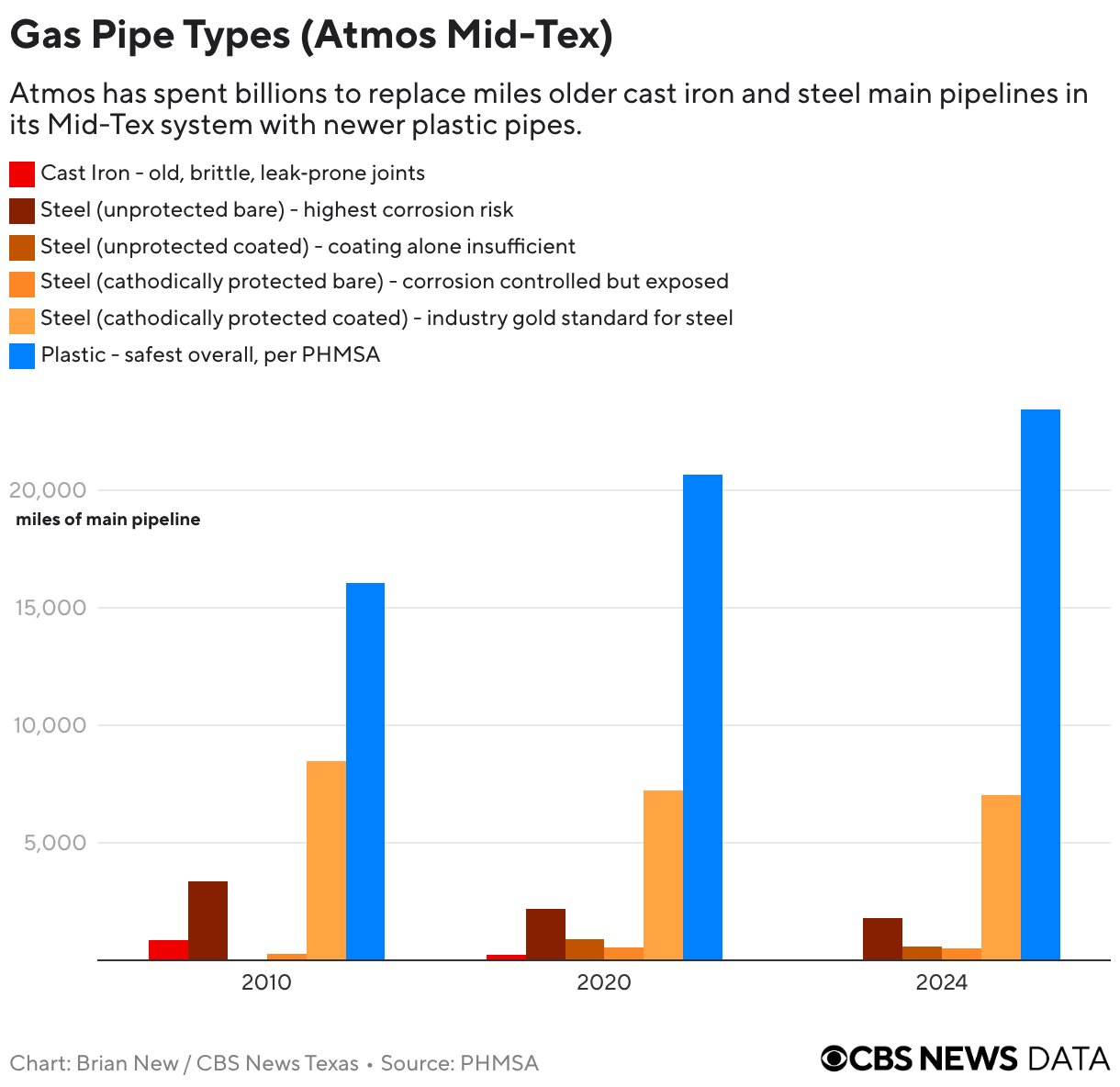
After a 2018 home explosion in Northwest Dallas that killed 12‑year‑old Linda Rogers, Atmos announced a sweeping effort to modernize its system, focusing on replacing older cast‑iron and bare steel pipes.
Since then, according to federal records, Atmos says it has replaced nearly 600 miles of bare steel pipe and eliminated all cast‑iron pipe in its Mid‑Tex division, which serves the DFW Metroplex. The effort cost $10.7 billion between 2019 and 2024, with expenses largely passed on to customers. The average monthly residential gas bill for Dallas customers has increased by nearly $40.
Despite recent investments, federal pipeline data shows that since 2019, the rate of hazardous leaks per mile of main pipeline in Atmos' Mid‑Tex division has increased, not declined.

Atmos says the rise reflects better detection and faster repairs, not worsening conditions. The company points to advanced monitoring technology, including a fleet of gas‑sniffing vehicles that survey pipelines from roadways. In 2025, Atmos says it surveyed more than 40,000 miles of pipeline in the Mid-Tex division.
Most hazardous leaks are caused by third-party digging. But state data also shows thousands of hazardous leaks every year are caused by other failures, and some are not discovered until it's too late.
In Grand Prairie in 2020, a natural gas leak ignited under a roadway, resulting in a fireball and forcing nearby evacuations. Investigators later traced that leak to a factory defect in the pipe.
In Carrollton in 2024, leaking natural gas entered a sewer system and triggered a home explosion that killed a man. Investigators said the leak was caused by a faulty fusion connection between two plastic gas pipes.
Critics say replacement alone may miss risks
Consumer advocates say the Lake Dallas case highlights a broader concern.
"The gas utilities are spending a lot of money," said Abe Scarr, energy and utilities program director for the Public Interest Research Group. "But not always in ways that are targeted to actually improve safety outcomes."
Scarr said in recent years, gas companies across the country have spent billions on pipeline replacement programs, focusing heavily on pipe age and material. He said such approaches are often inefficient at improving safety and can overlook localized warning signs, such as leak clusters, installation problems or areas with long histories of failure.
"All gas infrastructure can leak," he said. "Material alone doesn't tell you where the danger really is."
Atmos: safety remains top priority
Atmos says safety is its highest priority as it continues to invest billions in modernization, leak detection and damage prevention education, including urging contractors and residents to .
For Lake Dallas neighbors like Jake Sahl, who helped rescue the woman from the March explosion, the concern is personal.
"You don't know what you don't know – what's leaking, what's broke?" he questioned. "I just hope I don't blow up."